The Complete Guide to African Coffee: Origins, Regions & Flavours
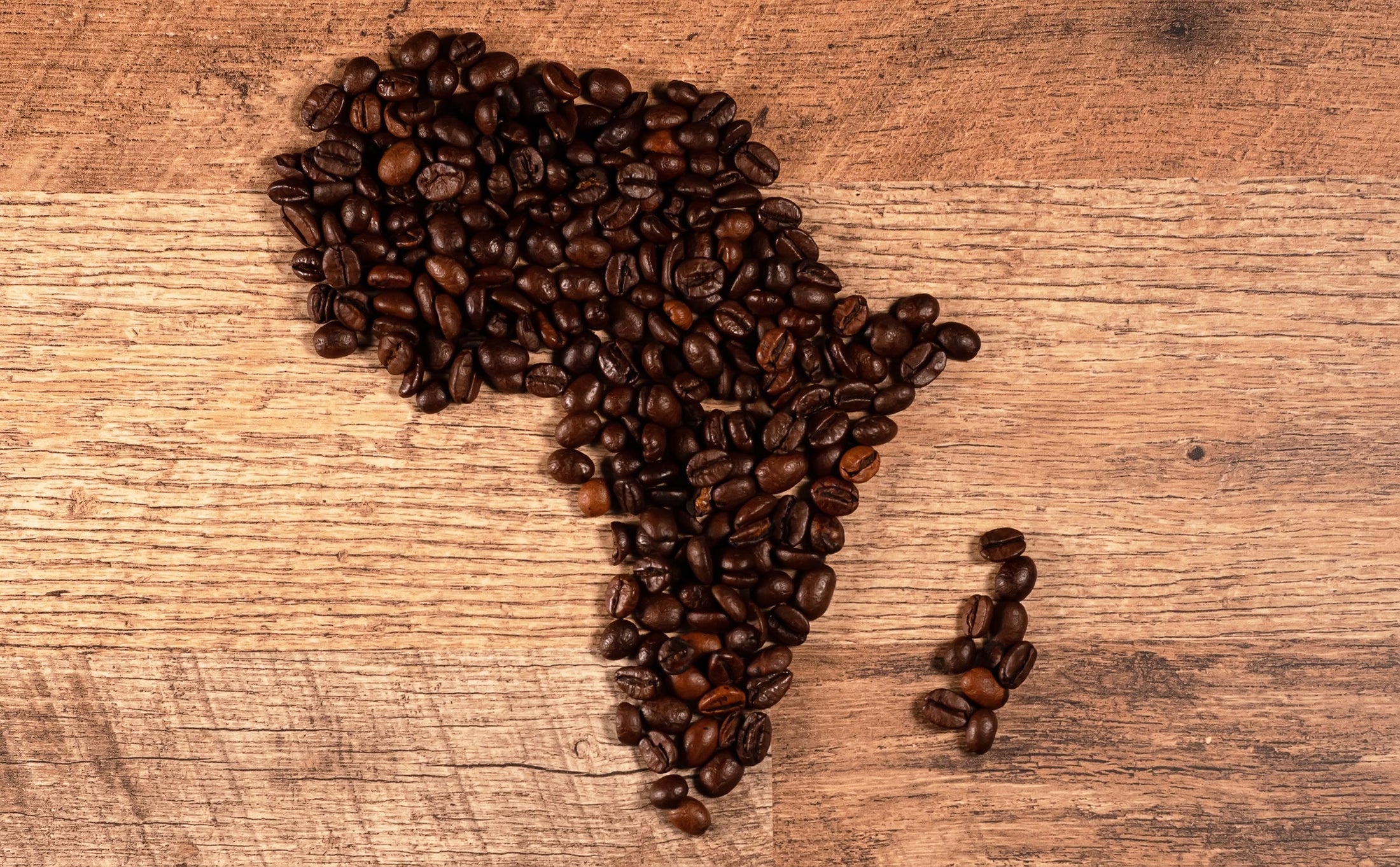
Africa is not just a place where coffee grows. It is where coffee began. Every cup poured anywhere in the world traces its lineage back to the forests of the Ethiopian highlands, where the Coffea arabica plant first grew wild. This guide is our attempt to gather, in one place, everything worth knowing about the coffees of Africa — their history, the countries and regions that produce them, the varieties grown, the climates that shape them, and the flavours you can expect in the cup.
It is written from where we stand: a roastery in Lusaka, Zambia, working with single-origin beans from across the continent. The five origins we cover in most depth — the Democratic Republic of the Congo, Ethiopia, Kenya, Rwanda, and Zambia — are the origins we know best, because they are the ones we roast.
The birthplace of coffee: a short history
The most enduring origin story belongs to Ethiopia. As legend has it, a goat herder named Kaldi, sometime around the 9th century, noticed his goats becoming unusually energetic after eating the bright red cherries of an unfamiliar shrub. Curious, he tried the fruit himself and felt the same lift. The story continues that he brought the cherries to a local monastery, where monks used them to stay awake through long hours of prayer — and the practice of consuming coffee for its stimulating effect was born.
The legend is almost certainly apocryphal, but the geography behind it is not. Coffea arabica is native to Ethiopia and the highlands around the Kaffa region, where it grew wild in the forests for millennia before anyone cultivated it deliberately. Serious cultivation is generally dated to around the 1500s, after which coffee crossed the Red Sea to Yemen, spread through the Ottoman world, and eventually reached Europe and then the rest of the globe. Almost every cultivated Arabica variety on earth — Bourbon, Typica, and the thousands that followed — descends from those original Ethiopian plants.
That heritage is why African coffee occupies such a particular place in the specialty world. Ethiopia alone is home to an estimated several thousand distinct coffee varieties, most of them grouped under the catch-all term "heirloom." Elsewhere on the continent, the story is often one of coffee introduced during colonial periods, flourishing, faltering through decades of political and economic upheaval, and — in country after country today — being painstakingly rebuilt as a specialty industry centred on quality and on the smallholder farmers who do the work.
What makes African coffee distinctive
There is no single "African" flavour, but there are common threads. African coffees are prized in the specialty world for brightness, complexity, and pronounced fruit and floral character — qualities that set them apart from the heavier, more chocolate-and-nut profiles often associated with other parts of the coffee-growing world.
Several factors converge to produce this. Much of Africa's specialty coffee grows at high altitude, where cooler temperatures slow the maturation of the cherry, allowing sugars and aromatic compounds to develop more fully and concentrate in the bean. Volcanic and mineral-rich soils, particularly through the East African highlands and around the Great Lakes, add depth. And generations of farming knowledge, combined with meticulous processing — washing, fermenting, drying — preserve the clarity that lets terroir express itself.
A note on two terms you will meet throughout this guide. Single-origin means a coffee from one country and, ideally, one specific region or even one washing station, rather than a blend of many — it lets the character of a place come through. Specialty grade refers to coffee that scores 80 or above on the coffee industry's 100-point cupping scale: the top tier, free of primary defects and rich in desirable flavour. Every coffee discussed below is best understood at that specialty level.
Ethiopia: the origin of origins
If you drink one African coffee in your life, it should probably be Ethiopian. As the birthplace of Coffea arabica, Ethiopia offers a genetic diversity no other country can match — thousands of indigenous "heirloom" varieties, many never formally catalogued, that give its coffees an aromatic range often described as "fruit bombs": intense florals, stone fruit, berries, and tea-like delicacy.
Ethiopian coffee is grown largely by smallholders, frequently in semi-wild "garden" and "forest" systems, at some of the highest elevations in the coffee world — which is part of why the cherries develop so slowly and so richly. Processing matters enormously here: washed (wet-processed) Ethiopian coffees tend to be cleaner, brighter, and more floral, while natural (dry-processed) lots are funkier, sweeter, and heavier with berry character.
Key Ethiopian regions
Yirgacheffe. Perhaps the most celebrated coffee name in Ethiopia, Yirgacheffe sits within the larger Sidamo area in the country's south-central highlands, grown at roughly 2,000 metres. Classic washed Yirgacheffe is prized for a clean, refined profile: vivid floral aromatics, citrus, stone fruit, a tea-like body, and lively acidity, often with hints of berry and chocolate.
Sidamo (Sidama). A broad region producing a wide spectrum of profiles, Sidamo coffees are typically sweet, floral, and citrusy with well-balanced complexity — notes of lemon, blackcurrant, and red cherry are common. Because the designation is large, it encompasses both Yirgacheffe and Guji.
Guji. Once considered part of Sidamo, Guji is now recognised in its own right for distinctly bright, fruit-forward cups — citrus like lemon and lime, floral notes, honeyed sweetness, and stone fruit such as peach and apricot. Natural-processed Guji lots lean sweet and berry-heavy.
Harrar. From the eastern highlands, Harrar is home to some of the oldest cultivated coffee and is almost always natural-processed. The result is intense and unmistakable: wine-like, fruit-forward, with blackberry, spice, and dark chocolate over a heavier body.
Limu and Kaffa. Limu, in the west, produces washed coffees with balanced acidity, mild citrus, and clean structure. Kaffa — the region whose name may well be the root of the word "coffee" — yields forest-grown coffees with herbal, floral, and wild complexity.
Kenya: the benchmark for brightness
If Ethiopia is the birthplace, Kenya is the perfectionist. Kenyan coffee is among the most distinctive and sought-after in the world, famous for an electric brightness and a signature note that tasters reach for again and again: blackcurrant, often alongside tomato-like savouriness, sparkling citrus acidity, and a clean, lingering finish.
Two things explain the Kenyan signature. The first is variety. In the 1930s, Scott Agricultural Laboratories developed two cultivars — SL28 and SL34 — that remain legendary. SL28 in particular produces a heavy body and the complex, blackcurrant-edged acidity Kenya is known for; SL34 is similar but slightly softer and performs well at higher altitude. The two are often grown and sold together (a bag marked "SL28/SL34" contains both). Newer disease-resistant hybrids like Ruiru 11 and Batian also appear, though purists prize the older SL lines for cup quality. The second factor is processing: Kenya's rigorous double-fermentation washed method, in which beans are fermented, washed, and fermented again, is credited with producing the country's hallmark clarity and brightness.
Key Kenyan regions
Nyeri. On the slopes of Mount Kenya, with volcanic soils and elevations around 1,700–1,900 metres, Nyeri is considered by many to produce Kenya's finest: intense blackcurrant, bright citrus acidity, and complex, well-balanced cups.
Kirinyaga. Also on Mount Kenya's slopes and one of the country's largest producing areas, Kirinyaga tends toward juicy, berry-forward fruit — cranberry, blackcurrant, red grape — with floral aromatics and lively acidity.
Embu and Murang'a. Embu offers bright fruit acidity and stone-fruit notes with a slightly lighter body, while Murang'a, at somewhat lower altitude, gives a more approachable, sweeter cup with orange and grapefruit and balanced acidity.
A word on the famous Kenyan AA grade: it denotes bean size, not flavour quality. A well-processed AB lot from a top estate can outshine a poorly handled AA. Always read the region, estate, and processing alongside the grade.
Rwanda: the land of a thousand hills
Rwanda's nickname — the land of a thousand hills — is also a description of its coffee terroir. High average elevations (commonly 1,200–2,000 metres), mineral-rich volcanic soils, and a landscape of steep hills produce dense, high-quality beans. The country is, in effect, a paradise for one classic variety: Bourbon, especially Red Bourbon, which dominates Rwandan production and is responsible for its refined, fruit-and-citrus character.
Rwanda's specialty industry is built around smallholders — hundreds of thousands of farmers, many tending tiny plots of a few hundred trees, delivering cherry to a dense network of more than 300 washing stations, most of them above 1,600 metres. The typical Rwandan cup is a sweet, full-bodied, fully washed Bourbon with bright acidity, red-fruit and citrus notes, and floral, tea-like elegance.
Key Rwandan regions and a note on the "potato defect"
The best-known growing areas cluster in the south and west near Lake Kivu — including the hills of Huye and Nyamagabe and lakeside Nyamasheke — along with areas around the Virunga Mountains, the Kizi Rift, Muhazi, and Akagera. Cup profiles lean toward lively fruit: red apple, red grape, citrus, and plum.
Honesty about a regional quirk: Rwanda and its neighbour Burundi (and parts of eastern DRC and western Uganda) are subject to the so-called "potato defect," in which an occasional individual bean carries a raw-potato aroma, caused by the antestia bug and associated bacteria. It is harmless and affects only isolated beans, but because a single affected bean can mar a brew, careful sorting at the washing station is part of what good Rwandan producers do. It is a challenge the industry actively manages, not a verdict on Rwandan quality — which, at its best, is superb.
Democratic Republic of the Congo: a paradise reborn
Eastern DRC was once described as "a paradise for coffee," and the geography justifies it. The Kivu provinces, north and south of Lake Kivu — one of Africa's Great Lakes — sit near the equator amid volcanic highlands, with abundant rainfall, high elevation, and deeply fertile soils: ideal conditions for specialty Arabica, predominantly the Bourbon variety.
The country's coffee history is bound up with hardship. Decades of conflict from the late 1990s onward devastated production; at the lowest points, farmers near Lake Kivu would reportedly cross the water by boat to sell their coffee in neighbouring Rwanda and Uganda. Today the story is one of revival. Cooperatives and investment projects — organisations of thousands of smallholders, washing stations built to specialty standards — are rebuilding the value chain and, with it, the reputation of Congolese coffee. It is one of the most exciting origins to watch in the world right now.
Key Congolese regions
South Kivu and North Kivu. The heart of DRC specialty production, from Bukavu in the south to Goma and beyond in the north, grown at elevations around 1,500–1,700 metres on volcanic soil. Well-made Kivu coffees can be complex and vibrant — expect bright acidity over a full body, with notes spanning plum, orange, brown sugar, brown spice, chocolate, and even pineapple and blueberry in standout lots.
Because so much Congolese coffee comes through cooperatives at washing stations, traceability and fair returns to farmers remain works in progress — which is exactly why direct, transparent sourcing matters here more than almost anywhere.
Zambia: our home origin
Zambia is where Imvelo roasts, and it is an origin on the rise. Coffee here is concentrated in the Northern Province, in the highlands around the Muchinga range, with growing areas including Isoka, Kasama, and Nakonde. The combination that makes good Arabica — high elevation, rich soil, sun and shade, and reliable moisture — comes together in these highlands, helped by proximity to the equator.
Zambian coffee, at its best, is bright and elegant, medium-to-full in body, with clean citrus notes and a refined character. It has historically been less famous than its East African neighbours, which means two things: it is often underrated, and there is real opportunity for carefully grown, carefully roasted Zambian lots to surprise people. Roasting it fresh, at origin, is central to how we believe its quality is best expressed.
Processing: the hidden hand in your cup
How a coffee is processed after picking shapes its flavour as much as where it grew. Three methods dominate across African origins.
Washed (wet) processing removes the cherry's fruit before drying, producing a clean, bright, transparent cup that showcases acidity and origin character. It is the norm in Kenya, Rwanda, much of the DRC, and for many of Ethiopia's most refined lots.
Natural (dry) processing dries the whole cherry around the bean, letting fruit sugars steep into it. The result is heavier, sweeter, and funkier — think intense berry and wine-like notes. It is traditional in Harrar and increasingly used for expressive Guji and Sidamo naturals.
Honey and experimental processing sit between the two, leaving some fruit mucilage on the bean during drying for added sweetness and body. Once rare in Africa, these methods are spreading as producers experiment.
How to brew African coffee
African coffees, with their bright acidity and delicate aromatics, generally reward brewing methods that prioritise clarity. Pour-over devices such as the V60 or Chemex, and immersion brewers like the AeroPress, let the fruit and floral notes sing. Water just off the boil (around 96°C) and a ratio in the region of 1:15 to 1:16 are good starting points.
For the most delicate coffees — washed Yirgacheffe, a bright Kenyan SL28 — a lighter roast and a paper-filtered pour-over preserve the complexity that makes them special; heavy dark roasting tends to flatten exactly the characteristics you paid for. Naturals and fuller-bodied lots, like a Harrar or a bold Kivu, also make excellent, fruit-driven espresso. And because these coffees are naturally sweet, most are best enjoyed black, with no sugar to mask what is already there.
Tasting African coffee, origin by origin
A quick reference to the flavours each origin tends toward, useful when you are choosing what to brew:
- Ethiopia — florals, stone fruit, citrus, berries; tea-like and aromatic. Washed lots clean and bright; naturals sweet and wine-like.
- Kenya — blackcurrant, bright citrus, savoury tomato edge; complex, clean, intense acidity.
- Rwanda — red fruit (apple, grape), citrus, floral and tea-like; sweet, full-bodied, elegant.
- DR Congo — plum, orange, brown sugar and spice, chocolate; full-bodied with vibrant brightness.
- Zambia — clean citrus, bright and elegant; medium-to-full body, refined.
The thread that connects them
From the wild forests of Kaffa to the hills of Rwanda, the slopes of Mount Kenya, the shores of Lake Kivu, and the highlands of northern Zambia, African coffee is bound together by a single inheritance: this is where the plant comes from, and these are the lands that still grow it best. What unites the great coffees of this continent is brightness, complexity, and a sense of place you can taste.
Every Imvelo coffee is a single-origin expression of one of these places, sourced from smallholder farmers and roasted fresh in Lusaka. Explore our single-origin African coffees, or build your own blend across origins and taste the continent for yourself.